
Learn how Australian gas bills work — daily supply charges, usage rates in c/MJ, block tariffs, and meter conversions. Clear examples backed by AER and ACCC sources.
Published on 19/03/2026
By Pallav Verma
Gas Comparison
Gas prices in Australia are made up of several distinct components and knowing what each one means can save you time, money, and confusion when your next bill arrives. This guide breaks down every charge you'll see on a gas bill or plan fact sheet, with plain-English definitions, worked examples, and links to official regulator sources so you can verify the details for your own situation.
Who this is for: Households connected to natural gas in NSW, VIC, QLD, SA, ACT, or TAS who want to understand their bill or compare plans more confidently.
Every gas bill in Australia includes a daily supply charge (a fixed daily fee for staying connected) and a usage charge (a variable fee based on how much gas you consume). Together, these two components make up the bulk of most residential gas bills.
Source: AER — About Energy Bills Fact Sheet, August 2025.
Gas usage is measured in megajoules (MJ) and billed in cents per MJ (c/MJ). Your gas meter records consumption in cubic metres (m³), which your retailer then converts into MJ using factors such as heating value, pressure factor, and volume correction. The final MJ figure appears on your bill.
Yes. Gas prices differ across states and distribution network zones because network infrastructure costs, pipeline distances, and gas supply arrangements vary by region. The Australian Energy Regulator (AER) oversees network pricing across the National Gas Network.
Some retailers offer discounts such as a pay-on-time or direct debit credit that only apply if you meet certain conditions. According to the AER, these are common plan features but must be read carefully, as the base rate (before the discount) is what you pay if conditions aren't met.
Yes. The government-operated comparison website Energy Made Easy (for NSW, QLD, SA, TAS, and ACT) lists verified gas offers from registered retailers at no cost to consumers.
Consumers can also use independent comparison platforms that display offers from a panel of participating energy providers. For example, electricityprovider.com.au allows users to explore and compare gas plans from participating retailers to better understand pricing structures, usage rates, and plan features available in their area.
Australian gas bills and plan information sheets are structured around a consistent set of pricing components. The AER requires retailers to display these charges clearly so customers can compare offers accurately.
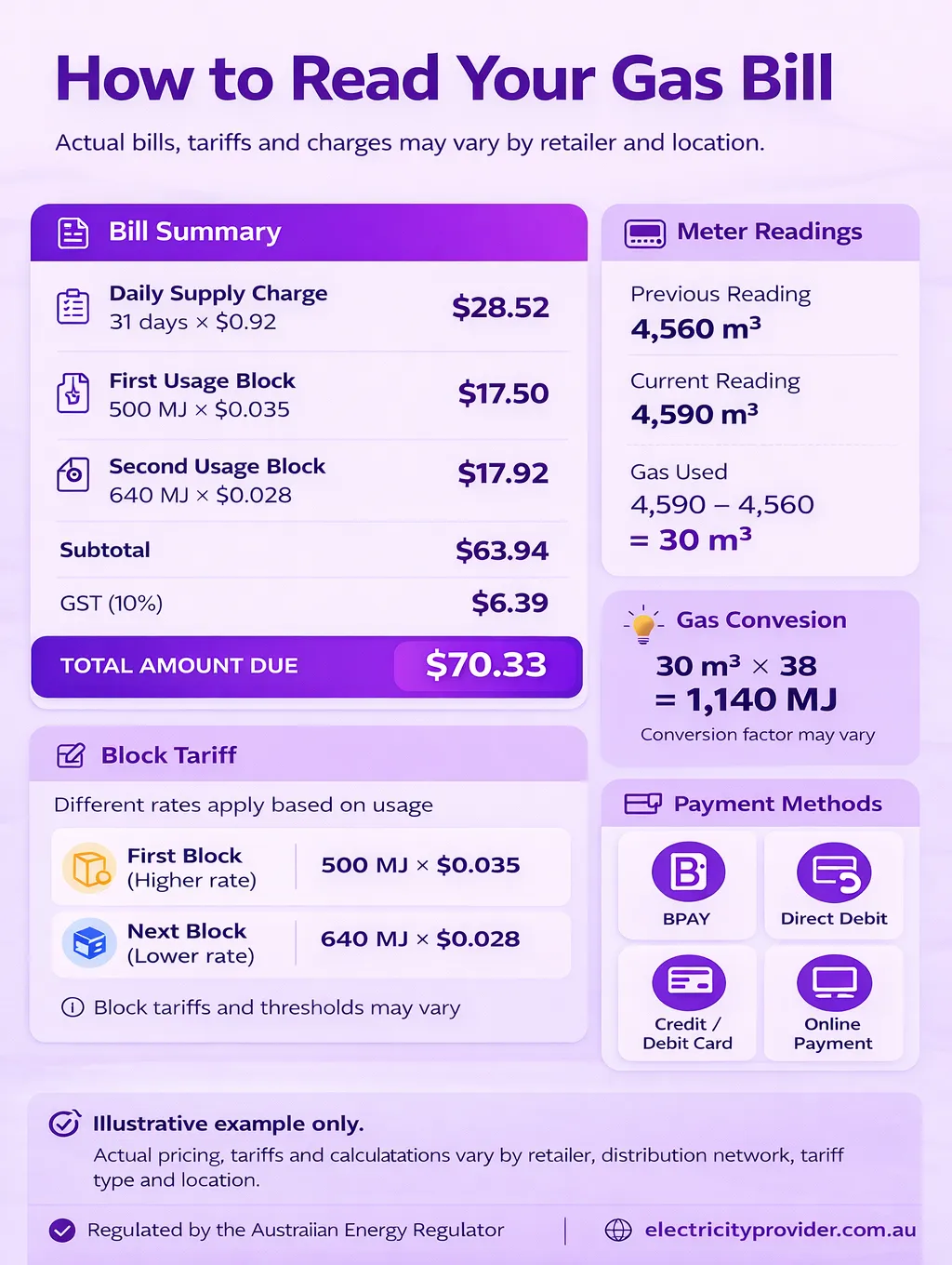
Here's what each section means.
The daily supply charge is the fixed cost of being connected to the gas network. You pay it every day — even on days when you use no gas at all.
It covers the cost of:
This charge is usually expressed in cents per day (c/day) and appears prominently on your bill or plan fact sheet.
Example (Illustrative Only)
|
Component |
Rate |
Annual Estimate |
|
Daily supply charge |
90 c/day |
$328.50/year |
Calculation: 0.90 × 365 = $328.50
Note: This is a hypothetical example for illustration only. Actual daily supply charges differ depending on your retailer, network distributor, state, and tariff. Always check your plan's fact sheet or contact your retailer for current rates.
The usage charge is the variable cost of the gas you actually consume. It is priced in cents per megajoule (c/MJ).
A megajoule (MJ) is a unit of energy. It measures the heat energy content of the gas delivered to your home — not the volume of gas itself.
Example (Illustrative Only)
|
Component |
Rate |
Annual Usage |
Estimated Cost |
|
Usage charge |
3 c/MJ |
20,000 MJ |
$600/year |
Calculation: 20,000 × $0.03 = $600
Note: Household gas consumption varies widely based on location, household size, heating systems, hot water type, and the time of year. The AER's Residential Energy Consumption Benchmarks (2020) show that average annual household gas use ranges from approximately 7,238 MJ in QLD to 49,799 MJ in VIC. Always use your own consumption data when comparing plans.
Semantic connection: Gas usage charges (c/MJ) are the gas equivalent of electricity usage charges (c/kWh). Both are regulated and must be disclosed on plan fact sheets.
Some gas plans use a block tariff structure, where the price per MJ changes once you cross a usage threshold. The first block of consumption is typically priced higher; additional usage above the threshold is charged at a lower rate.
Example (Illustrative Only)
|
Block |
Usage |
Rate |
Estimated Cost |
|
First block |
0–10,000 MJ |
3.5 c/MJ |
$350 |
|
Second block |
10,001+ MJ |
2.8 c/MJ |
$280 (next 10,000 MJ) |
|
Total |
20,000 MJ |
— |
$630 |
Note: Block tariff thresholds, rates, and the number of pricing tiers vary significantly between retailers and network distribution zones. Review the plan's pricing schedule for the exact tiers that apply to your address.
If you use a large volume of gas (e.g., a large household with gas heating), a block tariff may lower your effective per-MJ cost. If you use relatively little gas, a flat-rate plan may be simpler to track.
Your physical gas meter records consumption in cubic metres (m³). Before billing you, your retailer converts this figure into megajoules (MJ).
The conversion accounts for:
Simplified Example (Illustrative Only)
|
Meter reading |
Conversion factor |
Estimated MJ |
|
100 m³ |
38 MJ/m³ |
3,800 MJ |
Calculation: 100 × 38 = 3,800 MJ
Note: Actual conversion factors vary depending on gas composition and network location. Your retailer applies the specific factor relevant to your distribution network. This information is typically shown on your bill. Contact your retailer if you're unsure how the conversion has been applied.
Gas meters are generally read every three months and there is currently only one meter type for gas (manually read). Smart meters are not yet deployed for residential gas in Australia, as noted in the AER's About Energy Bills Fact Sheet.
Your gas prices are partly determined by which distribution network serves your address. Each state and region has its own network operator responsible for gas pipelines and infrastructure.
Because network infrastructure costs differ between areas, two households in different suburbs — or even different parts of the same city — can face different daily supply charges or usage rates.
|
State |
Example Network Operator |
|
VIC |
Australian Gas Networks (AGN), Multinet Gas, Gas Networks Victoria |
|
NSW |
Jemena Gas Networks |
|
SA |
Australian Gas Networks (AGN) |
|
QLD |
Allgas Energy, Jemena |
|
ACT |
Evoenergy |
|
TAS |
Tas Gas Networks |
The AER is responsible for regulating the revenue and pricing of gas distribution networks across most Australian states and territories. Network charges are passed through to consumers via retail pricing.
Victorian note: From 1 January 2025, customers in Victoria pay the full up-front cost of a new gas connection, rather than having that cost shared across all gas users. This change was introduced under the updated Gas Distribution Code of Practice (published by the Essential Services Commission). If you're connecting gas in Victoria, confirm current connection costs with your network operator before proceeding. Source: Victorian Government — Gas Substitution Roadmap.
Some gas retailers offer conditional incentives that reduce your bill — but only when specific conditions are met.
Common examples include:
According to the AER About Energy Bills Fact Sheet, retailers may also offer benefits such as discounted internet or mobile plans, memberships, reward points, or streaming subscriptions as part of energy offers.
Important: If a plan advertises a discount, check the base rate — the price before the discount is applied. This is the rate you'll pay if you miss a payment or don't meet the conditions. The ACCC's December 2024 Electricity Inquiry Report found that households on offers more than a year old were paying $238 more per year than households on newer offers. While this finding relates to electricity, the principle of regularly reviewing your plan applies equally to gas. Source: ACCC — No Reward for Being Loyal, December 2024.
If you haven't reviewed your gas plan in the past 12 months, it's worth checking whether a newer offer is available — either through Energy Made Easy or by calling your current retailer directly.
|
Charge |
Type |
Unit |
What It Covers |
|
Daily supply charge |
Fixed |
c/day |
Network connection and infrastructure |
|
Usage charge |
Variable |
c/MJ |
Gas energy consumed |
|
Block tariff (if applicable) |
Variable (tiered) |
c/MJ |
Consumption at different price thresholds |
|
Conditional discount |
Reduction |
% or $ |
Incentive for meeting plan conditions |
|
Meter read fee (if applicable) |
One-off |
$ |
Manual read or special read requests |
|
Connection/reconnection fee |
One-off |
$ |
Establishing or restoring supply |
The following relationships reflect how Australian gas pricing components connect:
Your usage is likely below 10,000 MJ per year. A flat-rate plan with a low supply charge may suit you better than a block tariff plan designed for high-volume users. Focus on comparing the c/day supply charge and the c/MJ usage rate.
You likely consume significantly more than the national average in winter. A block tariff — where the price per MJ decreases above a threshold — could lower your effective rate. Compare what the second-tier rate kicks in at and calculate your seasonal usage against that threshold.
Check whether: (a) your bill period is longer than usual, (b) a conditional discount was missed, (c) the bill is based on an estimated read rather than an actual meter reading, or (d) your retailer has updated its tariffs. The AER notes all these are common causes of unexpectedly higher bills.
If you're connecting gas to a new home, understanding the supply charge is important — you'll pay it from the day your connection is activated, even before your first meter read.
c/MJ stands for cents per megajoule. It is the standard unit used in Australia to price gas consumption. A megajoule represents the energy content of the gas you use. Your retailer multiplies your total MJ consumption for the billing period by the c/MJ rate to calculate your usage charge.
Your meter measures the physical volume of gas in cubic metres (m³). Your retailer converts this volume into megajoules (MJ) — a measure of energy — using factors that account for the gas's heating value, pressure, and temperature. The MJ figure is what you're actually billed for.
Gas prices differ by location primarily because of network distribution costs. Each region has its own gas distribution operator, and the cost of maintaining pipelines and infrastructure in that zone is passed through to consumers via retail plans. The AER regulates these network charges.
Retailers may estimate your bill if your meter cannot be accessed or if data cannot be retrieved. Your bill should state it is based on an estimate. Under Australian energy rules, if you were undercharged due to an estimate, your retailer must allow you to repay the shortfall in instalments. You can also request an actual read — though a fee may apply.
No. Different retailers pass through network costs differently and may structure their daily supply charges at varying rates. Two retailers serving the same suburb can have different supply charges. This is one reason why comparing plan fact sheets — not just usage rates — is important.
A block tariff prices gas in usage tiers — one rate for the first block of MJ consumed, and a different rate above that. Flat-rate plans apply a single c/MJ rate to all consumption. Neither structure is universally better. It depends on your actual consumption levels and the specific rates offered. Use your past bills to estimate which structure would cost less for your household.
In NSW, QLD, SA, TAS, and ACT, you can compare gas plans on Energy Made Easy, the government-operated comparison website run by the AER. In Victoria, use Victorian Energy Compare. You can also compare gas plans through Electricity Provider to see offers from retailers on its panel.
Disclaimer: The content provided is for informational purposes only and is based on publicly available information. While efforts are made to ensure accuracy, readers should independently verify all details with relevant energy retailers or providers. electricityprovider.com.au may earn a commission from selected providers when users switch energy plans via its platform. Not all plans or providers available in the market may be included in the comparison, and availability can vary depending on location and eligibility. This content does not constitute professional advice.


